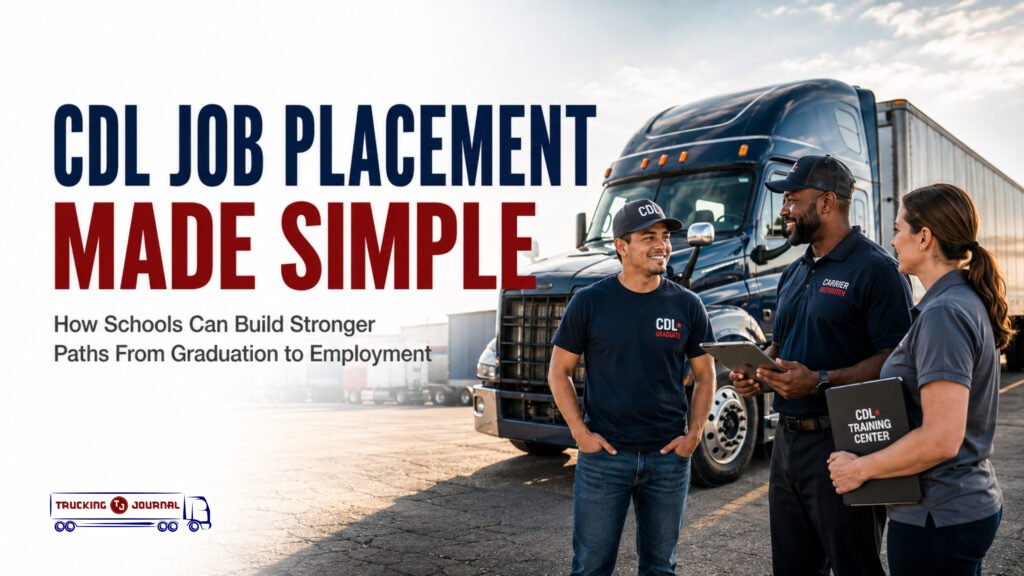
Most CDL schools promise opportunity. What students actually want is a job.
That gap between graduation and employment is where many programs lose trust, referrals, and long-term growth. Students are asking harder questions: “Will I be hired after this?” Meanwhile, carriers are struggling with driver shortages and inconsistent recruiting pipelines.
The solution is straightforward but underused: structured partnerships between CDL schools and carriers that create reliable job placement pathways.
Here’s how to build one that works for your students, your school, and your carrier partners.
We help connect Your Students with Hiring Carriers
Find out How, Schedule a Free Call
1. Start With Employer Demand, Not Curriculum
Many schools design programs first, then try to match students with jobs later. Flip that.
Build your training around what carriers are actively hiring for right now.
- Talk to regional and national carriers about their current driver needs, routes, and requirements.
- Align your training modules with real-world expectations (equipment types, safety standards, onboarding readiness).
- Prioritize certifications or endorsements that increase immediate hireability.
When your program reflects real hiring demand, placement becomes a natural next step, not a scramble.
2. Build Direct Relationships With Hiring Carriers
Job boards alone won’t create consistent CDL job placement. Relationships will.
You need active, ongoing partnerships, not one-off recruiter visits.
- Assign a point person to manage carrier relationships and placement pipelines.
- Set up regular check-ins with carriers to understand hiring trends and feedback.
- Invite carriers to engage with students early through guest talks, facility visits, or mock interviews.
This shifts your school from “training provider” to “talent pipeline.”
3. Create a Structured Driver Placement Program
If placement is informal, results will be inconsistent. A defined process changes that.
Think of it as a system, not a favor.
- Establish a clear handoff process from graduation to carrier recruitment.
- Track each student’s placement status and follow up until they’re hired.
- Pre-screen students based on carrier requirements (background checks, availability, location).
A structured driver placement program increases both placement rates and employer confidence.
4. Prepare Students for Hiring, Not Just Driving
Passing the CDL test isn’t enough. Carriers want job-ready drivers.
The schools that stand out are the ones that prepare students for the hiring process itself.
- Train students on application workflows, documentation, and compliance requirements.
- Run mock interviews focused on real carrier expectations.
- Educate students on job options, local vs. OTR, pay structures, and lifestyle trade-offs.
Better-prepared students get hired faster and reflect well on your program.
5. Use Data to Improve Placement Outcomes
You can’t improve what you don’t track.
Placement success should be measured, analyzed, and optimized over time.
- Track key metrics: placement rate, time-to-hire, carrier retention, and student satisfaction.
- Identify which carriers consistently hire and retain your graduates.
- Adjust partnerships and training focus based on real outcomes, not assumptions.
Data turns your placement program from reactive to strategic.
Where Most Schools Get Stuck
Even with the right strategy, execution can be the bottleneck.
Schools often struggle to:
- Find and connect with reliable hiring carriers.
- Manage multiple relationships efficiently.
- Keep placement pipelines active and updated.
That’s where a dedicated “School + Carrier Partnership” model comes in.
Instead of building everything from scratch, you can plug into a system designed to connect your graduates with carriers who are actively hiring, creating a smoother path from classroom to cab.
Turn Your CDL Program Into a Hiring Pipeline
If your goal is to increase enrollments, improve student outcomes, and build a stronger reputation, placement can’t be an afterthought.
It needs to be part of your core offering.
By aligning with carriers, structuring your placement process, and leveraging the right partnerships, you can deliver what students actually care about: a clear path to employment.
And when you do that, everything else, growth, referrals, and credibility, follows.
Building stronger placement outcomes starts with better communication between CDL schools and hiring carriers. If you are looking for a practical way to improve those connections, the next step is to start a conversation about what your program or fleet needs.
Build a Reliable Placement Pipeline
Schedule Free Consultation